§ TOOLS / CIPHER LAB / KNIGHTS TEMPLAR
Knights Templar cipher
The Knights Templar cipher writes each letter as a wedge: a piece of a cross-shaped figure, pointed in one of four directions, with a dot added for the second half of the alphabet. It is a symbol cipher like pigpen, built on a Maltese cross instead of a tic-tac-toe grid, and on the Science Olympiad Codebusters papers OlyPrep has read that include it, no reference is provided, so the whole figure has to be drawn from memory.
What the Knights Templar cipher is
The figure behind the cipher is a Maltese cross, four arms meeting at a point, and the letters sit in the arms and the spaces between them. In the version the lab uses, three parent shapes, which the reference grid calls the Star, the Cross and the Diamond, each hold four letters at the top, right, bottom and left positions. A to D sit on the Star, E to H on the Cross and I to M on the Diamond, with I and J sharing a place, in the order the reference grid shows; N stands alone as a small X of two diagonal strokes. A symbol is one arm of its parent shape, drawn with its point toward the centre: an open chevron for the Star, a closed triangle for the Cross, a kite for the Diamond.
That accounts for fourteen letters. The remaining twelve reuse the same shapes with a small dot inside: O to R take the Star positions with a dot, S to V the Cross, W to Z the Diamond. So the symbol for a letter says three things at once, which parent shape, which direction it points, and whether it carries a dot, and all three must be right. The cipher is commonly attributed to the medieval Knights Templar, though the attribution is hard to verify; what is certain is that it appears in puzzle books and scout manuals, usually beside the pigpen cipher.
Decoding is matching symbols to the drawn figure. Draw the three shapes with their letters in place, add the dotted set, then take each symbol in the message, match its outline and direction to a wedge, and read the letter, remembering the dot. I and J share a wedge and are told apart by the word they land in. A gap between symbols is a word break. The work is almost all in the drawing: a student who can produce the full figure correctly reads the message in a minute or two.
The mistakes are the mistakes of memory. Putting the letters in the wrong order around a shape, confusing a Star arm with a Cross arm, and forgetting that the dot changes the letter are the usual three. The remedy is to practise the figure on its own, with no message, until it can be drawn cold and checked against a reference, and only then to decode. Of the symbol ciphers on elementary papers it asks the most of memory, which is also why it is worth learning early.
How to solve a Knights Templar cipher
A Maltese-cross grid pattern — 26 letters arranged in cross-shaped wedges. The cipher symbol shows the SHAPE of the wedge containing the letter. Decoding = matching the symbol back to its wedge position on your hand-drawn grid.
- STEP 1: Draw the Maltese-cross grid from memory on scratch paper.
- STEP 2: Fill in the alphabet across the wedges (with dot variants for the second half).
- STEP 3: Decode — each cipher symbol is the shape of the wedge around its letter.
- TIP: Templar is the most memory-heavy of the cipher set — drill the grid alone first until you can redraw it cold, then start practicing decodes.
A worked example
Worked example
Decoded plaintext: SCIENCE
(Each ciphertext symbol → wedge shape on the Maltese-cross grid → letter.)
Three parent shapes — Star (A B C D), Cross (E F G H), and Diamond (I/J K L M) — each holding 4 letters at N/E/S/W cardinal positions, plus N alone with an X-saltire. Dotted variants carry the second half of the alphabet (O P Q R · S T U V · W X Y Z). Each cipher symbol is one arm of its parent shape with the tip/apex pointing INWARD; a small filled dot inside the shape marks the dotted variant. I and J share the diamond-top position.
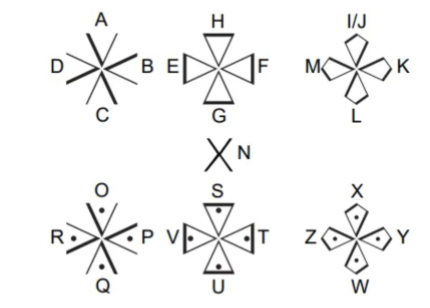
The most memory-heavy of the cipher set — drill until you can redraw the full grid from scratch in under 60 seconds.
Knights Templar in Codebusters
Among the Science Olympiad rule sets OlyPrep has read, the Knights Templar cipher appears on the Milpitas elementary list, where it is one of the ciphers not on the resource sheet: the student redraws the figure from memory, which that tournament allows on scratch paper at the start of the test. The Bay Area, Macomb, Virginia and Division B lists OlyPrep has read do not name it.
Scoring is usually by the letters of the decoded message, and a decoded quotation with up to two wrong letters is commonly counted as solved. A wrong wedge costs several letters at once, not one, so the time spent getting the drawing right before decoding is repaid. Draw it first, check it, then read.
The lab below draws each challenge as symbols, and the card above carries a reference drawing of the figure. Reveal puts each letter beneath its symbol, so a decode can be checked wedge by wedge. Practise with the reference in view until the figure is familiar, then cover it and draw your own before each challenge, which is what the day asks.
Practice the Knights Templar cipher
The lab below is set to the Knights Templar cipher alone. Pick a difficulty, generate a challenge, decode it, then check your answer or reveal the solution. It runs in your browser, needs no account, and is unlimited on every OlyPrep plan.
Scoped to Knights Templar · 1 cipher type. Generate a challenge, solve it, and we'll track what you've cracked.
Your first decode is the hardest.
Pick a cipher above and give it a shot — we'll keep track of what you've solved.
Where the Knights Templar cipher is tested
The Science Olympiad rule sets OlyPrep has read that name this cipher:
- Milpitas Elementary Science Olympiad (MESO) — on the Codebusters list; not on the resource sheet, so the figure is drawn from memory
Cipher lists change with each season’s rules; a tournament’s own rulebook is the authority on what it tests.
Questions about the Knights Templar cipher.
- Q·01How is the Knights Templar cipher different from pigpen?
- Both are symbol substitutions, and both put the second half of the alphabet on the same shapes with a dot added. Pigpen draws its symbols from the lines around a letter’s space in a tic-tac-toe grid or an X; Knights Templar draws them from the wedges of a Maltese cross, so the symbols are pointed shapes rather than corners and boxes.
- Q·02Do I get the Knights Templar grid on a Codebusters test?
- On the rule sets OlyPrep has read that include it, no: the figure is not on the resource sheet, and the student redraws it from memory on scratch paper. That makes it the most memory-dependent cipher on those papers and the one most worth drilling on its own.
- Q·03How does the OlyPrep lab check a Knights Templar answer?
- The lab draws the symbols, you type the decoded words, and it compares your letters against the message it encoded, ignoring spaces. Check says whether the letters match; Reveal shows the solution and puts each letter under its symbol.
- Q·04Is OlyPrep affiliated with Science Olympiad?
- No. OlyPrep is independent and is not affiliated with Science Olympiad, Inc. or any state or regional Science Olympiad organization. Each tournament’s rulebook decides whether the cipher is on its list and whether a reference is provided.